
How to Use Thermal Imaging in Hunting: A Complete Guide to Boosting Your Success Rate

In modern outdoor hunting, thermal imaging technology has evolved from high-end gear into an essential partner for hunters and outdoor enthusiasts. Unlike traditional optical scopes or low-light night vision devices, thermal imaging requires zero visible light. Instead, it generates images by capturing differences in infrared radiation—temperature variations—between a target and its surroundings.
Whether navigating dense forests, fog-filled valleys, or pitch-black nights, thermal devices help hunters “see” targets hidden in the dark. But how exactly should thermal imaging be applied during a hunt? This article outlines the core use cases and practical techniques you need to know.
1. Four Core Hunting Applications for Thermal Imaging
1) All-Weather Reconnaissance in Dark or Severe Conditions
Many game species (such as wild boars, deer, and wolves) are highly nocturnal, remaining most active at night, dusk, or dawn. While traditional optical scopes fail entirely in the dark, thermal night-vision gear overcomes these lighting limits:
Zero-Light Exploration: In pitch-black deep mountains or dense forests, thermal imaging converts heat emitted by animals into high-contrast visuals.
Weather Penetration: When thick fog, heavy rain, or dust scatters visible light, long-wave infrared (LWIR) continues to penetrate, keeping your line of sight clear.
2) Cutting Through Foliage and Natural Camouflage
Wild animals possess natural camouflage, allowing their fur to blend effortlessly into timber or tall grass.
Bypassing Camouflage: Animal body temperatures are typically higher than nearby trees, rocks, and foliage. Thermal devices highlight targets hidden behind bushes or thick brush in bright modes (such as White Hot or Red Hot).
Wide-Area Scanning: Sweeping a 360-degree area with a handheld thermal monocular takes only seconds, allowing you to detect large warm-blooded animals quickly and boost search efficiency.
3) Post-Shot Blood Tracking and Game Recovery
Locating injured or downed game after a shot is often one of the most challenging parts of a hunt, especially in dense brush or at night.
Residual Heat Spotting: After an injured animal lies down in the grass, its body temperature remains higher than the surrounding environment for a time. Thermal imaging helps hunters pinpoint the location quickly to prevent lost game.
Thermal Trail Following: Blood trails left by running game—as well as fresh footprints—generate subtle temperature differences that high-end thermal units can help track.
4) Positive Target Identification and Field Safety
Safety is always the top priority during any hunt. Thermal equipment significantly reduces the risk of accidental shots:
Positive Identification (PID): By observing body contours, movement patterns, and heat signatures, you can verify that the target is a legal game species rather than a hunting dog, fellow hunter, or livestock.
Background Safety Scans: Before pulling the trigger, scan the area behind your target with thermal imaging to ensure the shot background is clear of people or hidden obstacles.
2. Thermal Imaging vs. Traditional Night Vision
Many beginners confuse thermal imaging with traditional low-light night vision. In practical hunting, their differences are distinct:
| Performance Dimension | Thermal Imaging Devices | Traditional Night Vision |
| Light Dependency | 100% ambient light independent (0 Lux) | Requires ambient light or an Infrared (IR) illuminator |
| Camouflage Detection | Outstanding (detects body heat directly) | Moderate (relies on shape/contrast, easily tricked by brush) |
| Daytime Usability | Yes (usable day or night) | No (bright daylight ruins sensor intensifier tubes) |
| Fog/Vegetation Penetration | Excellent | Poor |
| Detail & Texture | Focuses on heat contours; lower surface detail | Near-natural vision; shows fur texture and facial details |
3. How to Choose and Pair Thermal Gear
To maximize efficiency in the field, pair different thermal devices based on your hunting phase:
Detection and Spotting Phase: Handheld Thermal Monocular
Features: Lightweight, compact, and easy to operate single-handed.
Use Case: Scanning for targets while walking or from a blind over long periods without causing arm fatigue from raising a heavy firearm.
Aiming and Shooting Phase: Thermal Rifle Scope / Clip-on Unit
Features: Built-in reticles, high recoil resistance, and ballistics features.
Use Case: Mounted directly to the rifle for precision aiming and target acquisition.
Key Specifications to Watch:
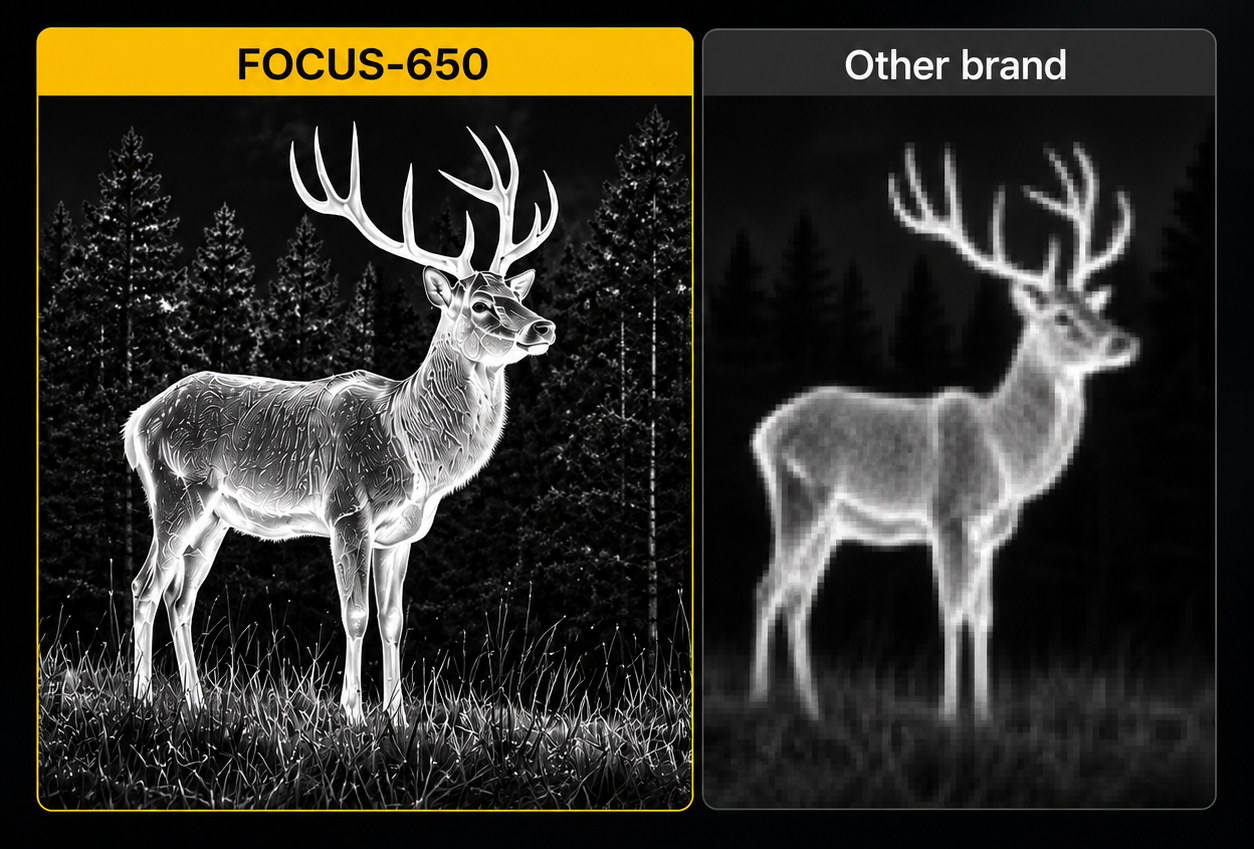
Sensor Resolution: Common resolutions include 384×288 or 640×512. Higher resolution provides sharper target details over long distances.
Thermal Sensitivity (NETD): Devices rated at NETD < 25mK perform significantly better in humid conditions or low-temperature-difference environments.
Refresh Rate (Hz): Look for 50Hz or higher to ensure smooth, lag-free tracking of moving animals.
Summary
Integrating thermal imaging into your hunting strategy not only multiplies your efficiency in locating game, but also drastically enhances safety during night hunts. From early-stage area scanning to precision targeting and post-shot recovery, thermal technology has become a vital part of modern hunting